

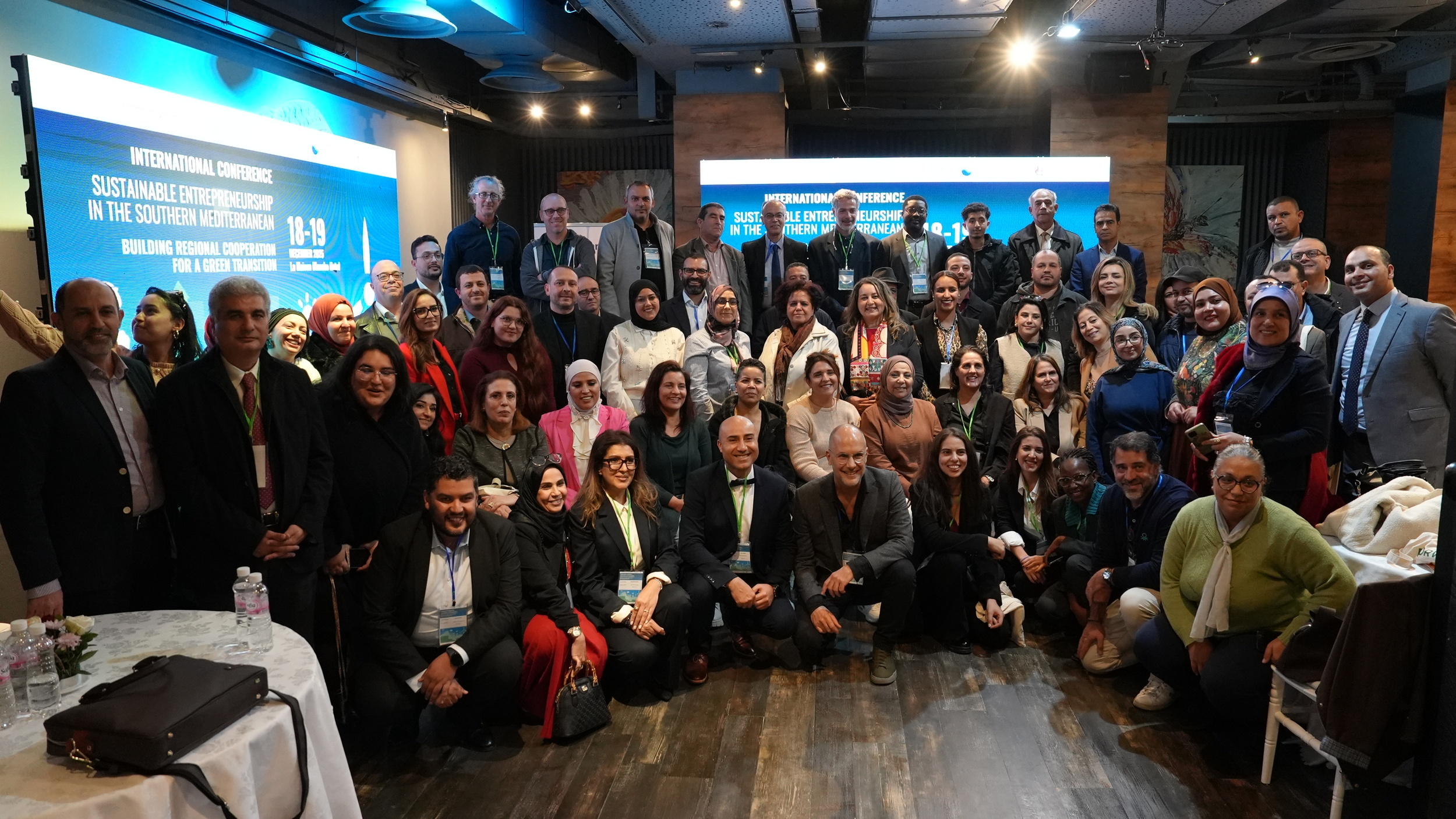
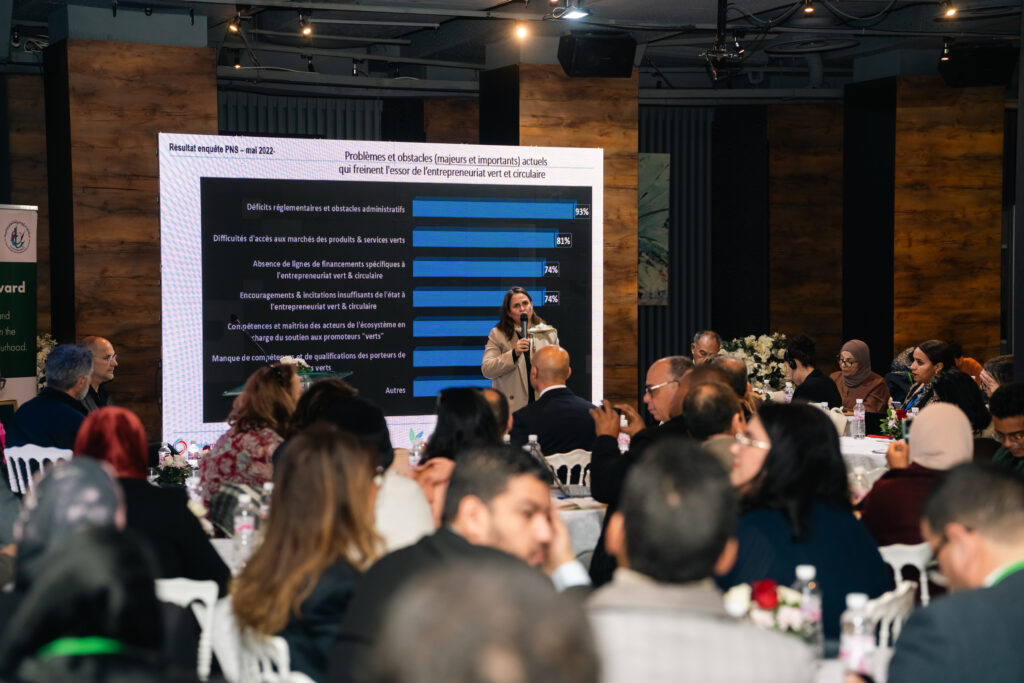
Tunis hosted, on 18 and 19 December 2025, the international conference “Sustainable Entrepreneurship in the Southern Mediterranean: Regional Cooperation for a Green Transition”, co-organised by MedWaves (UNEP/MAP Regional Activity Centre for Sustainable Consumption and Production) and CITET (International Centre for Environmental Technologies of Tunis). The conference was held within the framework of the Sustainable Business Support Programme, funded by UNEP/MAP and the Government of Catalonia, and the Green Forward programme supporting Business Support Organisations, funded by the European Union and implemented at the meso level by the international non-governmental organisation SPARK. Over two days, more than 90 organisations from eight countries across the Mediterranean region shared experiences and laid the foundations for strengthened regional cooperation in support of the green and circular economy.
Discussions highlighted the strategic role of Business Support Organisations (BSOs) in transforming economic models. According to Ms Kmaira Ben Jannet, Director General of CITET, “environmental and social challenges in the Southern Mediterranean require a break from traditional models. The transition to a circular economy represents a unique opportunity to stimulate innovation and strengthen territorial competitiveness.” Ms Ben Jannet stressed that the success of this transition depends on strengthening BSO capacities and networking them at the regional level.
Giorgio Mosangini, Team Leader for Sustainable Entrepreneurship and Civil Society at MedWaves, recalled that “the economy is a subsystem of the environment,” emphasising that the success of entrepreneurs engaged in the circular economy depends on the strength of the ecosystem surrounding them. He presented the Mediterranean Cooperation Manifesto as a structuring tool designed to give a formal identity to a regional network committed to a just, inclusive, and sustainable transition.
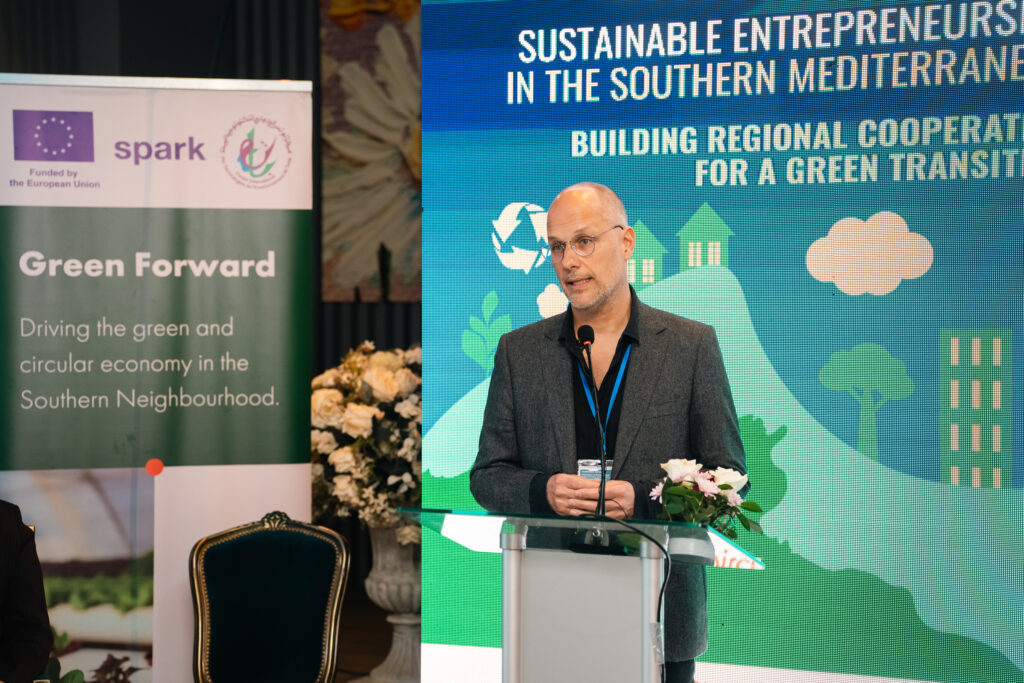
Giorgio Mosangini – MedWaves
For Ms Christel Bultman, CEO of SPARK, “in the face of climate change impacts, it is vital to reduce the environmental footprint of the economy while creating the jobs of tomorrow.” She emphasised the role of BSOs as essential intermediaries between entrepreneurs, investors, and public decision-makers, capable of translating on-the-ground needs into effective policy advocacy. She also highlighted Tunisia’s strategic position at the crossroads of Africa and Europe as a testing ground for green industrialisation.
The conference was also marked by the sharing of concrete experiences from participating countries, illustrating the diversity of approaches and the richness of ecosystems supporting sustainable entrepreneurship in the Southern Mediterranean and the MENA region.
In this regard, CEDARE (Egypt) presented an analysis of policies supporting the development of sustainable enterprises in MENA countries, highlighting institutional levers conducive to the emergence of green ecosystems. REMESS (Morocco) demonstrated how public policies can act as catalysts to institutionalise the social and solidarity economy in support of sustainable entrepreneurship. Leaders International (Belgium) offered a comparative analysis of business support systems in Jordan, Palestine, and Tunisia, identifying convergences, transferable good practices, and areas for improvement. In Palestine, the B-Hub centre stressed the strategic importance of networking among support organisations to ensure the sustainability of entrepreneurship in a constrained context. The Tunisian experience was illustrated by RedStart, which showed how strategic partnerships can foster the emergence of green entrepreneurship fully integrating a gender perspective. ALFANAR (Jordan) highlighted the evolution of impact philanthropy in the MENA region and its growing role in supporting support structures and impact-driven enterprises. Finally, RAMA Impact (Lebanon) identified specific challenges and needs related to financing green and social enterprises, particularly those led by women, calling for more adapted and inclusive financial mechanisms.
The highlight of the conference was the adoption of the Mediterranean Cooperation Manifesto, which now commits regional stakeholders around ten areas of action, ranging from sustainable innovation and financial mobilisation to inclusion, policy advocacy, and knowledge sharing. This foundational text aims to make sustainable entrepreneurship the economic norm in the Southern Mediterranean.
Through this conference, CITET, MedWaves, and SPARK reaffirmed their commitment to sustainably bringing together regional stakeholders, strengthening support ecosystems, and accelerating the transition towards greener, more inclusive, and more resilient economies. The event also confirmed Tunis’s position as a regional hub for reflection and action in support of sustainable entrepreneurship in the Southern Mediterranean.
************************************
The Mediterranean Manifesto was adopted at the end of the Tunis conference by around fifteen organisations from across the Mediterranean region. The result of an intensive collaborative process, the text now commits regional actors around ten concrete areas of action:
1- Innovation and sustainable value: Adopt innovative approaches (eco-design, eco-innovation, circular economy) to maximise environmental and social value while minimising negative impacts. This includes promoting fair labour relations and participatory governance.
2- Internal expertise: Continuously develop the capacities and expertise of organisations to better support entrepreneurs on their sustainability journey.
3- Inclusion and equity: Ensure a just transition by prioritising support for women, youth, and marginalised communities, so that no one is left out of the circular economy.
4- Transparency and impact: Establish robust monitoring, evaluation, accountability, and learning systems to measure and transparently report the real impacts of initiatives.
5- Knowledge sharing: Freely exchange resources and experiences and make these learnings accessible to the public to accelerate collective progress across the Mediterranean.
6. Collective action and networking: Coordinate activities and launch joint initiatives at national and regional levels with all organisations sharing these values to amplify impact.
7- Market access: Collaboratively stimulate demand for sustainable products and services while raising consumer awareness to challenge unsustainable practices.
8- Financial mobilisation: Engage financial actors to direct grants, loans, and capital towards circular enterprises.
9- Global awareness-raising: Widely disseminate knowledge on sustainable business models to make them the new economic norm.
10- Policy advocacy: Advocate collectively for enabling regulatory frameworks that create a level playing field for green enterprises to thrive and penalise polluting practices.


 Print
Print